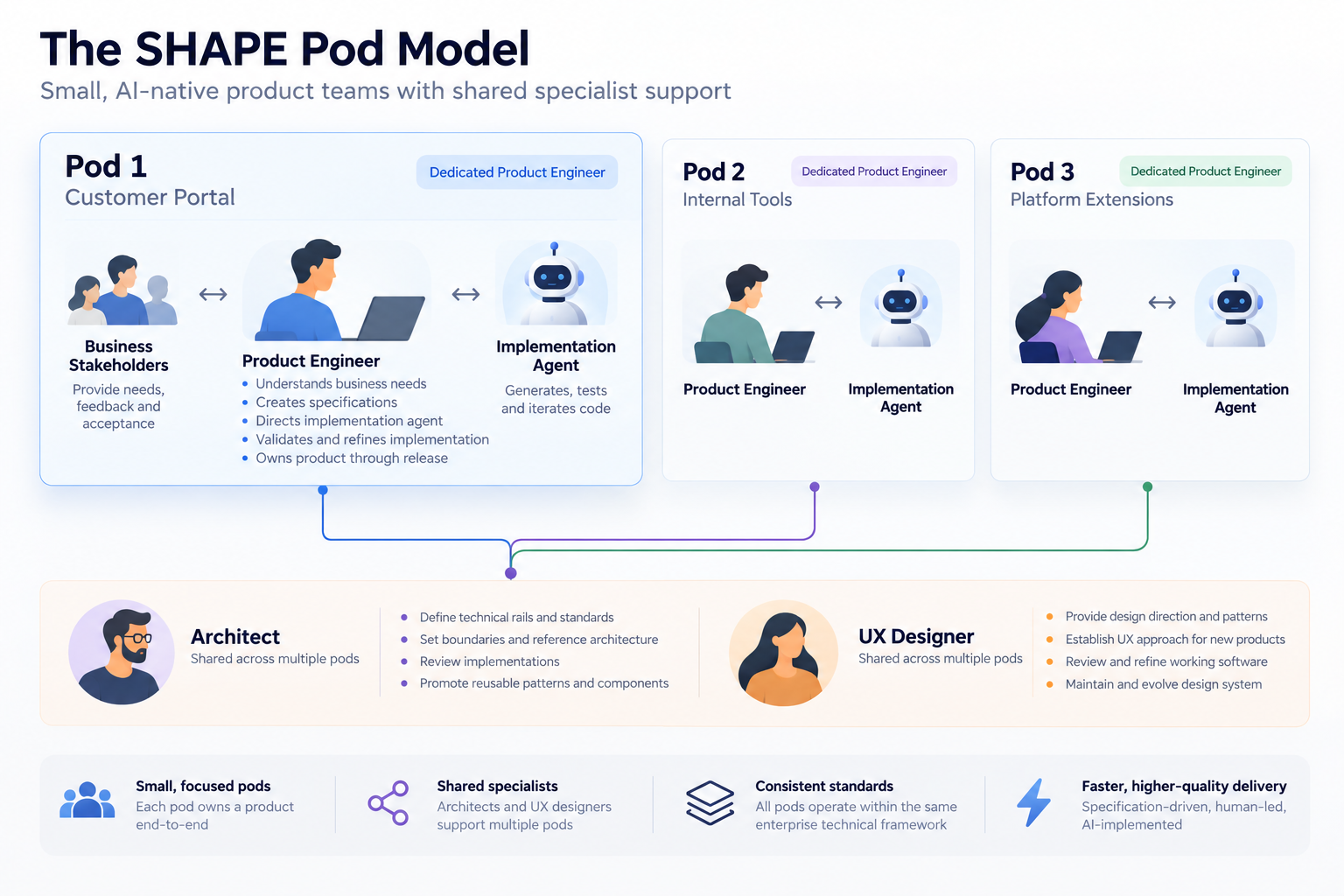
Small pods, clear ownership, shared expertise
The SHAPE Framework centers software delivery on the Product Engineer, a human responsible for connecting business needs to specifications, directing AI coding agents, and evaluating working functionality. Architects or senior engineers and UX designers contribute specialist expertise across a limited number of products or pods.
This organization is intentionally small. The premise is that as coding agents take on much of the implementation workload, not every product needs a traditional team of dedicated developers, analysts, designers, and delivery coordinators working sequentially. It still needs accountable people who understand the domain and can recognize unsound results.
The Product Engineer is the continuous link
The Product Engineer leads discovery, owns the quality of specifications, uses agentic tools to implement and refine behavior, and coordinates reviews and acceptance. The role is hands-on, technically capable, and close to the business. It is not limited to writing requirements for someone else to implement.
Ownership continues over the product's life. A Product Engineer may maintain multiple applications, but only within a portfolio that remains manageable. Maintenance, business changes, security or standards updates, and dependencies must be included when assessing capacity.
Specialist roles are shared, not removed
The architect establishes technical boundaries, helps with consequential decisions, and reviews implementation for correctness, security, and maintainability. The UX designer provides early direction for interactions and user experience and revisits the functioning application as it becomes concrete.
Their involvement need not be identical for every feature. A complex integration or risky technical change can require substantial architect attention. A familiar workflow using an established design system may require lighter UX involvement than a product introducing new interaction patterns.
Stakeholders work with actual behavior
Business stakeholders remain active participants. They articulate goals and constraints, review working flows, clarify ambiguous requirements, and make acceptance decisions. Their feedback can change specifications and implementation through iteration. UAT follows the enterprise's normal acceptance practices.
Capacity is a design constraint
Sharing specialists improves leverage only if their workload remains realistic. A Product Engineer overseeing too many products will lose context and neglect maintenance. An architect spanning too many teams becomes a bottleneck. The framework expects organizations to set sensible limits based on product complexity, change frequency, risk, and availability, rather than applying a universal number of applications per person.
Explore the roles
Read the detailed descriptions of the Product Engineer, Architect / Senior Engineer, and UX Designer. The Product Ownership & Capacity page covers enduring responsibility and workload limits.